
"A bra size is a portrait of your body at a single point in time. Hormones shift breast volume across the cycle. Pregnancy and nursing change breast tissue substantially — and the body that emerges is rarely the same as the one before. Weight change, perimenopause, menopause: each brings its own shifts in density, shape, and position. A size worn for years without review is, more often than not, no longer the right one.”
THE QUICK ANSWER:
The most common signs you’re wearing the wrong bra size are: your band rides up at the back, your straps dig in or slide off, your cups overflow or gape, your underwire sits on breast tissue rather than your chest wall, and you feel discomfort or fatigue by the end of the day. A correctly fitted bra should feel secure, supported, and virtually invisible to wear.
Emma Da Silva has spent eighteen years designing and engineering bras. As Intimo’s Head of Collection Design, she has thought more carefully about fit, construction, and the relationship between a woman’s body and her lingerie than most people will in a lifetime. We asked her to tell us what she knows, and how commitment to comfort, support and fit has shaped Intimo's design philosophy.
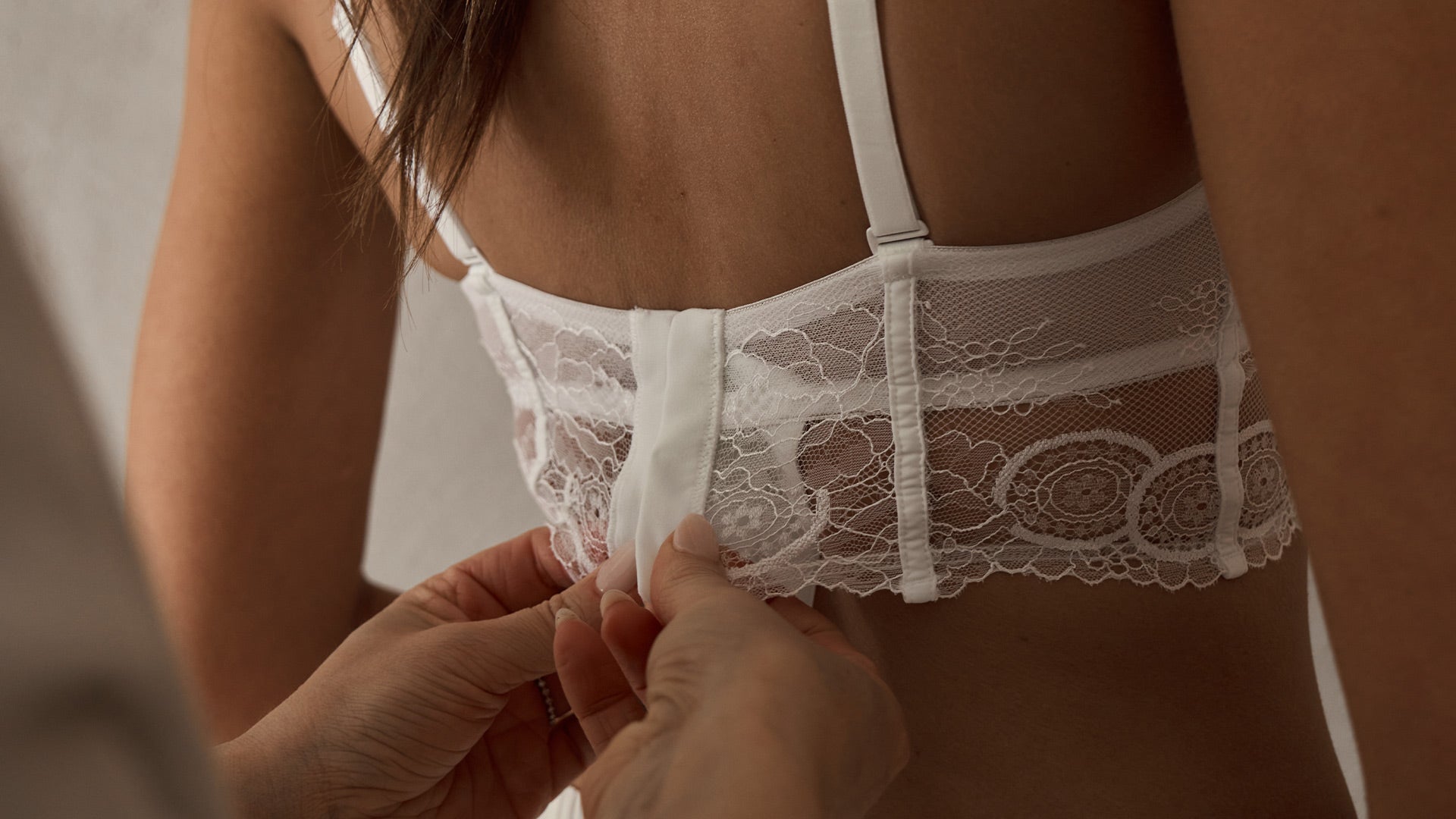
The majority of women are, at any given point, wearing the wrong bra size. Not by choice — by drift. The body changes, quietly and continuously, and women believe their size stays the same. Most women were fitted once, years ago, and have worn that number ever since. Meanwhile, everything else has moved on.
There are seven things we look for immediately — and most of them, women have stopped noticing because they’ve simply accepted them as normal.
1. Your band rides up at the back
“The band provides around 80% of a bra’s support. When it rides up or curves up your back rather than sitting level it tells you the bra is too big in the band. The natural weight of the breast pulls the bra down flattening the chest and not supporting the breast at all. The straps then compensate the hold and create pressure at the shoulders.
Tip: Lift both arms overhead with your bra on. If the band rises with you, it’s too loose.
2. Your straps dig in or slide from your shoulders
“Straps are designed to guide, not carry weight. If there digging in, the band isn’t doing enough. And straps that slide off the shoulder? That can point to a band that maybe too wide for your frame, or a bra whose geometry simply doesn’t suit yours. It’s never just a strap issue.”
3. Your cups overflow or gape
“Tissue spilling over the upper or outer edge means the cup volume is insufficient. Wrinkling or gaping means the opposite. The error I see most often is women going up in band size to compensate for a cup that’s too small — it can look like the cup fits, while the band loses all its hold. It might look better at first, but you’ve just shifted the problem rather solve it”.
4. Your underwire sits on breast tissue
“You typically hear woman complain about the discomfort a bra wire can give them. The underwire should follow the natural based of the breast, sitting against the chest wall. When it sits on soft tissue instead, the architecture of the bra is working against the body it’s meant to support. What women accept as inevitable discomfort, in most cases is simply the wrong fit.”
5. You’re adjusting your bra throughout the day
"A bra that fits requires very little of your attention. Pulling straps up, tugging the band down, repositioning the cups throughout the day is not part of wearing a well-fitting bra. It’s evidence that the bra is not working. A correct fit becomes, over the course of a day, effectively unnoticeable.”
6. You carry tension in your neck or shoulders
“When the band doesn’t hold, the weight of the breast transfers into the shoulders and upper back. The connection is rarely obvious to the person carrying it — which is precisely why so many women live with this tension for years without ever tracing it to their bra.”
7. Your bra leaves marks at the end of the day
“Deep impressions from the band or straps that persist after you remove your bra are a sign that something is gripping where something else should be holding. The right bra leaves your body feeling supported. Not
relieved to be free of it.”
So what does the right fit actually feel like?
“The band sits level and firm — parallel to the floor, front and back. The underwire rests against the chest wall, not against tissue. The cups hold everything cleanly, with no spillage and no excess. The straps guide without digging. You put it on, and within minutes, you stop thinking about it entirely. That is the measure of a correct fit. Not how it looks. How quickly it disappears.”
And for a woman who hasn’t been fitted in years — what would you say to her?
“Come in. That’s all. You don’t need to know what’s wrong or what size you think you are. That’s what we’re there for.”
How do I know if I’m wearing the wrong bra size?
The clearest signs are a band that rides up, straps that dig or slide, cups that overflow or gape, an underwire pressing on breast tissue, and discomfort or tension that accumulates through the day.
Can wearing the wrong bra size cause pain?
Yes. When the band doesn’t hold, the weight of the breast transfers into the shoulders and upper back — contributing to neck tension, shoulder pain, and fatigue. Most women make the connection only after
experiencing a correct fit.
How often should I be professionally fitted?
Once a year at minimum, and whenever your body changes significantly — after pregnancy, breastfeeding, weight change, or during perimenopause and menopause.
Is it worse to wear a bra that’s too big or too small?
Neither serves you. Too small compresses tissue and restricts movement. Too large cannot provide adequate support, placing strain on the shoulders and back. A correctly fitted bra is the only version that
works as intended.
How can I check my bra fit at home?
The band should sit level with two fingers passing beneath it — but no more. The underwire should follow the breast’s base without pressing into tissue. Cups should sit smooth and flush. Straps should not require adjusting across the day.
How many women are wearing the wrong bra size?
Research and professional fitting data consistently indicate that the majority of women are wearing a bra that doesn’t fit — most often because the body changed and the size didn’t.
